BEATING HEART OF THE WORLD
The Taos Art Colony, the Pueblo Resistance, and the Battle for Indigenous America
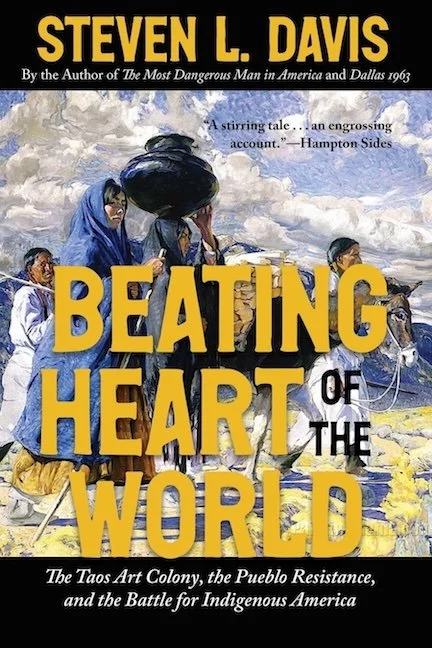
“A wonderfully researched history of the Indigenous people of Taos and their long struggle for autonomy. Beating Heart of the World is a story of tenacity, community organizing, and ultimately justice. Above all, it is the tale of the power of resistance. What an inspiration for our times! Much gratitude to Steve Davis for this effort.”
~Sandra Cisneros, author of The House on Mango Street and Woman Without Shame: Poems
“Beating Heart of the World tells the stirring tale of how the savvy stewards of Taos Pueblo forged an unlikely though slyly effective alliance with bohemian newcomers to protect Indigenous lands and tribal traditions that seemed on the brink of extinction. In Steven L. Davis’s engrossing account, we are reminded why Taos has long been such a fervent crossroads of anti-establishment thought and aesthetics. Here, art meets politics in unexpected, eccentric, and often bewitching ways.”
~Hampton Sides, New York Times bestselling author of Blood and Thunder and The Wide Wide Sea
“These people worked together, over time, to reverse injustice and succeeded. That is such an important tale to tell . . . at any time but perhaps especially in our current climate of discord, division, and distrust.”
~Sherry L. Smith, author of Bohemians West: Free Love, Family, and Radicals in Twentieth Century America
“In Beating Heart of the World, author Steven L. Davis arranges all the pieces of a complex and mysterious puzzle. A federal government bent on dispossessing Native America. The canny but beleaguered leaders of Taos Pueblo fighting against impossible odds for their survival. And the artists, writers, dreamers and bohemians of the Taos art colony who leveraged their worldwide fame in their cause. A compelling and inspiring story, beautifully told.”
~Bryan Burrough, author of Forget the Alamo: The Rise and Fall of an American Myth
The fascinating true story of how Taos Pueblo’s Indigenous people recruited members of the famous Taos art colony to help spark a movement for Native justice that reshaped the nation.
When the first white artists arrived in Taos by horse-drawn wagons, centuries of military conquest and brutal government policies had pushed Indigenous people to the brink of collapse. New Mexico’s pueblos had become some of America’s last holdouts of traditional culture, resolutely preserving their sacred lands in the face of mounting pressure.
Many of the free-spirited newcomers in Taos came to admire the pueblos’ peaceful, communal societies and holy regard for the natural world. To these outsiders, pueblo civilization offered a marked contrast to America’s record of endless war, hyperindividualism, and environmental destruction.
Among those attracted to Taos was the “Queen of Bohemia,” a wealthy New York heiress who dabbled in peyote and personified radical chic. Mabel Dodge Luhan fell in love with Taos Pueblo leader Tony Lujan and hoped to inspire an American spiritual renaissance based on pueblo values. She brought world-famous luminaries to Taos, including D. H. Lawrence, Georgia O’Keeffe, and Carl Jung, along with the fiery social reformer John Collier.
As the art colony gained international fame, the US government targeted the pueblos for extinction, moving to seize their lands and destroy their cultures. This same grim scenario had played out countless times before in US history. It seemed that nothing could stop the brutal crush of conquest.
But the puebloans, who had once unleashed a fierce revolt against Spain in 1680, found a new way to fight back in the modern era. As master diplomats, they began recruiting the prominent creatives converging on Taos, shrewdly enlisting them as political allies. And these artists and writers, at a crucial moment in history, rose to join the pueblos and challenged their own culture’s prevailing genocidal policies.
Beating Heart of the World is the fascinating, fast-paced chronicle of a long-shot resistance movement that grew into a powerful national campaign for Indigenous justice. While a work of history, Beating Heart of the World speaks urgently to our own era as new resistance movements percolate—and as new generations increasingly look to ancient Indigenous wisdom to help guide sustainable pathways forward.